Sub-Total

Beyond ADA: Disability and Access in Independent Theater

Photo: Felicia showing off our access equipment station!
Heyo, friends! Today I've invited a special guest to the blog to talk about something we hold in high importance around Fringe: ACCESSIBILITY! You may be aware that we add access services like ASL, audio description (AD), and open captioning (OC) to shows during the festival, but did you know that we also carry AD and OC equipment and make it available for rental to the greater Twin Cities theater community???? WE DO!
Let me introduce our Director of Audience and Volunteer Engagement, Felicia Cooper to tell you all about it!!
In Minnesota, we are lucky in many ways. On any given Tuesday night, I can see daring, innovative, and skillful artists presenting new work. Whether it’s at one of our beloved Fringe Festival venues or not, independent or otherwise, time and again we are treated to performing arts unafraid of risk.(I’m imagining a supercut here of all the things you might do in a week that would make your aunt in Edina go “that’s different”), I often tell people that my favorite part of working at Minnesota Fringe is simply helping make this city a place where weird art can thrive. Diversity of artistic expression is great, but diversity of audience can be halted if your performances aren’t accessible.
Let’s get this out of the way: hosting your work in an ADA-compliant venue is the bare minimum you can do without looking like a jerk. Elevators, ramps, and seating prepared for folks with mobility issues are great, but it’s also your legal obligation to comply.* (This is why a Front of House person has probably asked you not to block the ramp at Rarig Thrust). As arts administrator and author Howard Sherman asked in his 2016 essay for HowlRound, “Is the ADA a tool that people with disabilities may need to be reminded to use (dare I say wield) in conjunction with the arts? Perhaps it is. But there’s no reason why theatres can’t proactively review and bring themselves into compliance with it. If equity, diversity, and inclusion are truly goals for the field, accessibility should be as well. And not just because it’s the law.”
However, beyond booking ADA-compliant venues, there are a number of tools at your disposal. None of them are catchall magic wands of accessibility, but they all can be useful with the appropriate planning. Please note that I do not identify as a person with a disability, and my advice is from the perspective of someone who works in Audience Services. There are more appropriate consultants available to help you, and any person with a disability is going to have a well of knowledge far deeper than my own. I defer to their experience and leadership, but I thought I’d offer a primer on how to consider using the resources at your disposal. Your first tool, of course is
Forethought and communication
Accessibility planning should happen while you’re planning your season, not when your tickets go on sale and you’re scrambling to also juggle last-minute props, problem solve scene transitions, and print programs. The earlier you can identify the accessibility needs of your audience and artists, the better equipped you are to meet their needs. This also means that you can communicate opportunities and market performances to the appropriate parties. In an ideal world, you can ask people directly what they need. Some key questions:
- Who do I hope this show reaches?
- How can I make sure it reaches them?
- Are there any barriers to that happening?
Your next tools are potentially more tech heavy, but Minnesota Fringe can help! We have the following tools available to rent (at a discount for theater makers and companies who are fiscally sponsored by we).
Audio Description Equipment
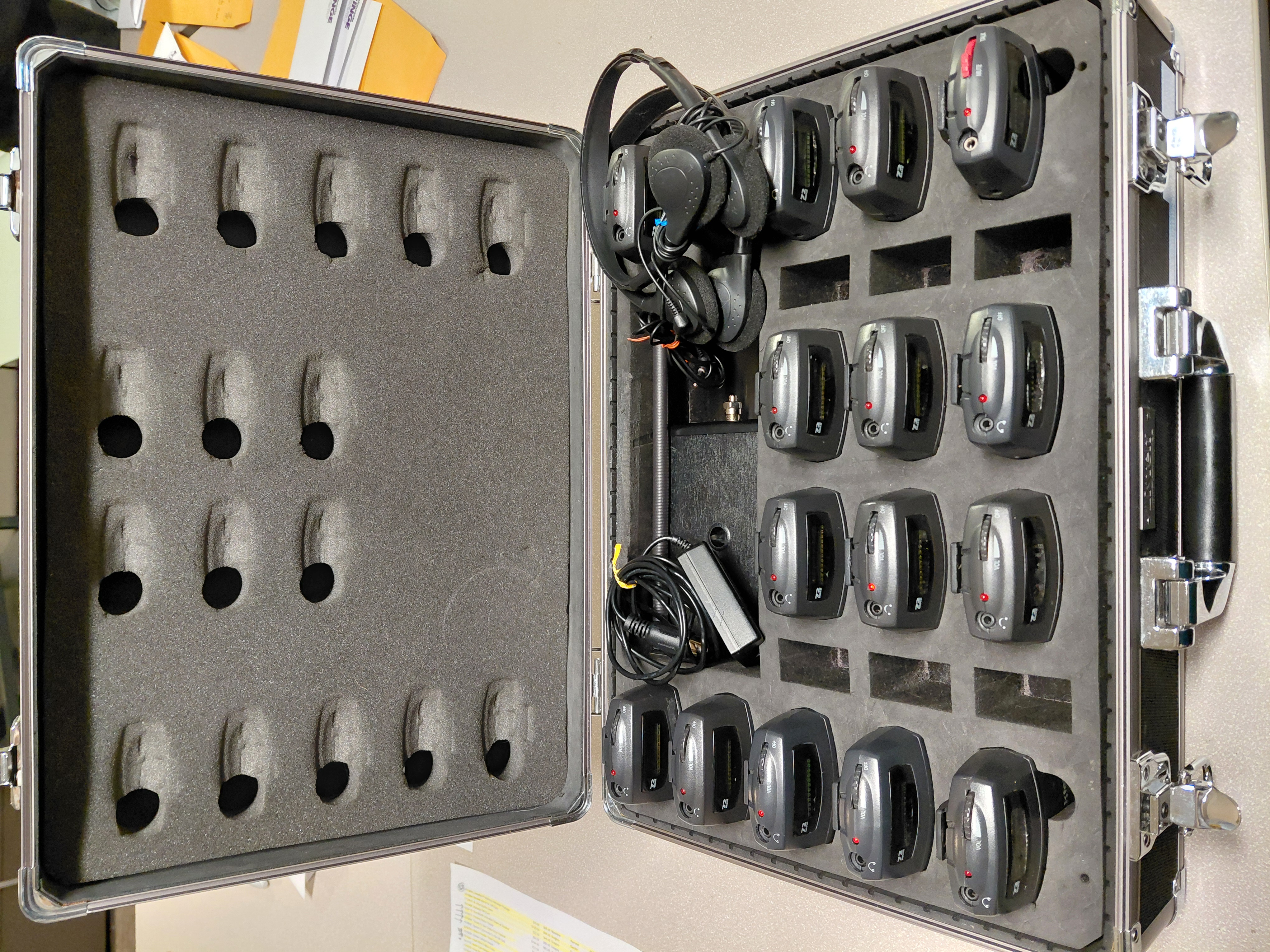
A box of goodies: audio description receivers and headphones in an AD charging case.
This is equipment that allows a trained professional to describe the show to a person with low vision and blindness. Typically, a theater contracts an Audio Describer, who watches the show before the performance they are describing. They will take notes and then arrive at the designated performance with equipment: a stenographer’s mask or microphone and a variety of earbuds and t-coil options from which the patrons can choose to use. They usually meet patrons using their service at a dedicated place in the lobby or at the box office. During the performance, the Describer is located away from the audience so that they can describe the show, narrate the visual elements of a show between dialogue and may offer some background information or a tactile tour of costumes and set pieces prior to the performance. to the patrons using their service without distracting fellow audience members. Some key questions:
- Does the show contain visual elements, subtext, or blocking that, if described, would enhance a verbal plot?
- Are there patrons who would benefit from this service?
- Can I work within a timeframe which allows the Describer to see the show before describing it live?
- Do I have the budget to hire an Audio Describer?
- How will I communicate with patrons that this service is available?
Open Captioning Equipment
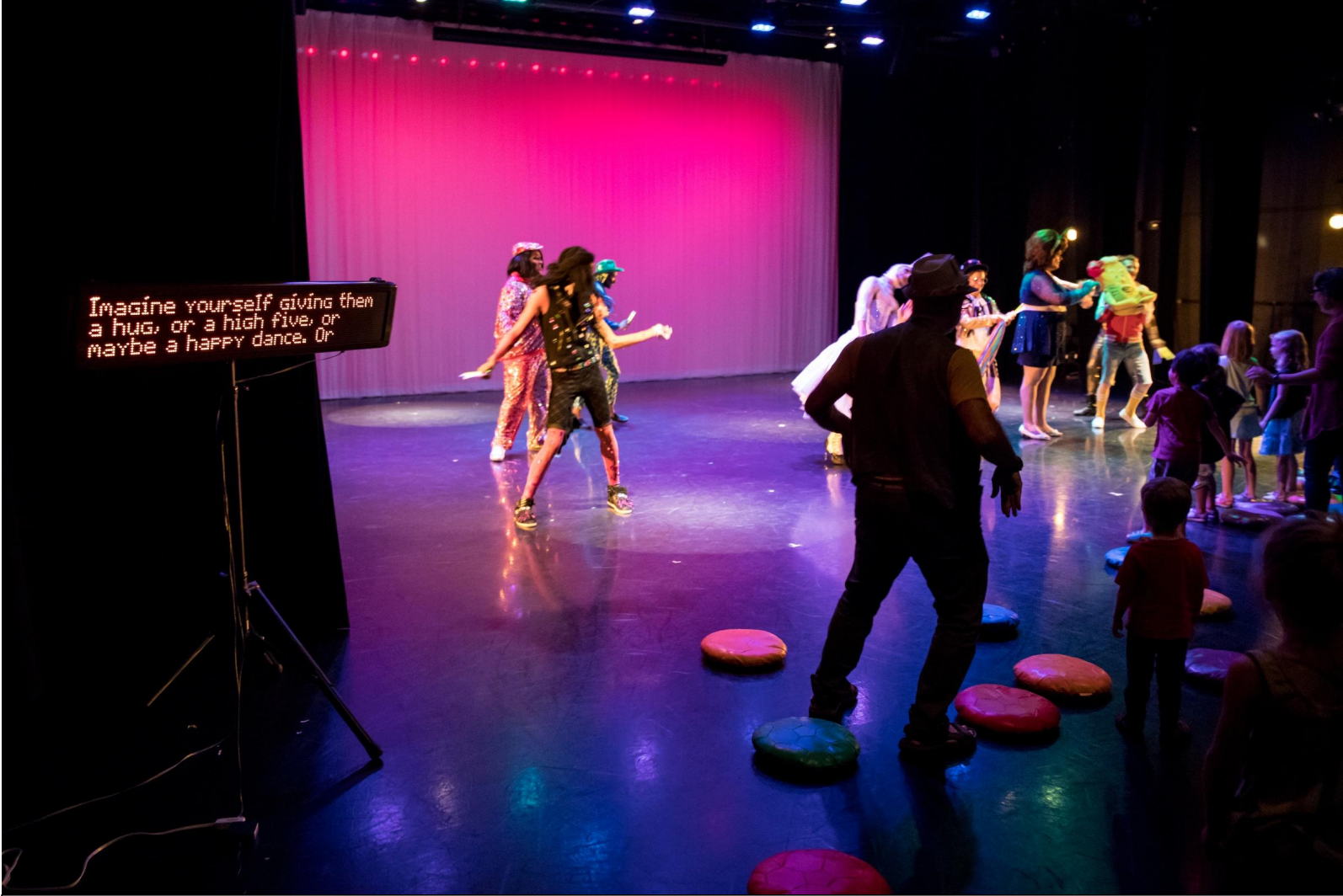 An example of open captioning in action!
Super Drag Story Time by Storyland Magic Carpet at 20219 Minnesota Family Fringe, photo by Dan Norman
This is new equipment for Minnesota Fringe and we are very excited about it! Our open captioning machine is a portable screen which transmits the lines of the play as they are being spoken. It’s useful for folks with a range of hearing loss, auditory processing disorders, deafness and more. Dawn, a frequent lip reader, finds it especially helpful when people are speaking with accents or singing during a show. Here’s how it works: The producer provides a script and hires a captioner to ‘scrub’ the script of extraneous information so that the machine can read it. This is a straightforward process, but there is a learning curve involved. During the show, someone will be responsible for running a computer loaded with appropriate software and moving the script along, accommodating any stumbles, pauses, or mishaps that can happen in live theater. Some key questions:
- Is there a written script?
- Will the script be finished in time to have it scrubbed prior to the performance?
- Are there patrons who would benefit from this service?
- Where will I place the Open Captioning Machine?
- Do I have the budget to pay someone to scrub the script and hire a Captioner during the performance?
- How will I communicate with patrons that this service is available?
ASL Interpretation
.png)
This is perhaps one of the most recognizable tools of accessibility in theater. While Minnesota Fringe hires ASL Interpreters during the festival, we aren’t directly connected with any Interpreters, we recommend using these services to find some:
Keystone Interpreting Solutions is a Deaf- and woman-owned partnership of two nationally known Deaf and hearing interpreters with over thirty years of community-based interpreting experience and over ten years of developing, managing, and providing video remote interpreting services. Keystone Interpreting is Minnesota based and provides a variety of interpreting services.You submit a request and they will reach out to you if they think they can fill your needs.
ASLIS provides on-site sign language interpreters for Deaf, DeafBlind, hard of hearing and hearing individuals throughout Minnesota, North Dakota and wes tern Wisconsin. They work with over 300 well-trained and highly skilled interpreters.
*ADA laws were hard won by Disabled folks, and I highly recommend the documentary Crip Camp for more on this fascinating history.
** This article is focused on access for patrons with disabilities. Some more thoughts on artists with disabilities can be found here. https://howlround.com/interesting-thoughts-access-inclusion-and-disability